Historic Victorian, colonial, and triple-decker wood structures across Hartford, from the West End and Asylum Hill to Frog Hollow and Barry Square, regularly face wood-boring activity from *Camponotus pennsylvanicus*…
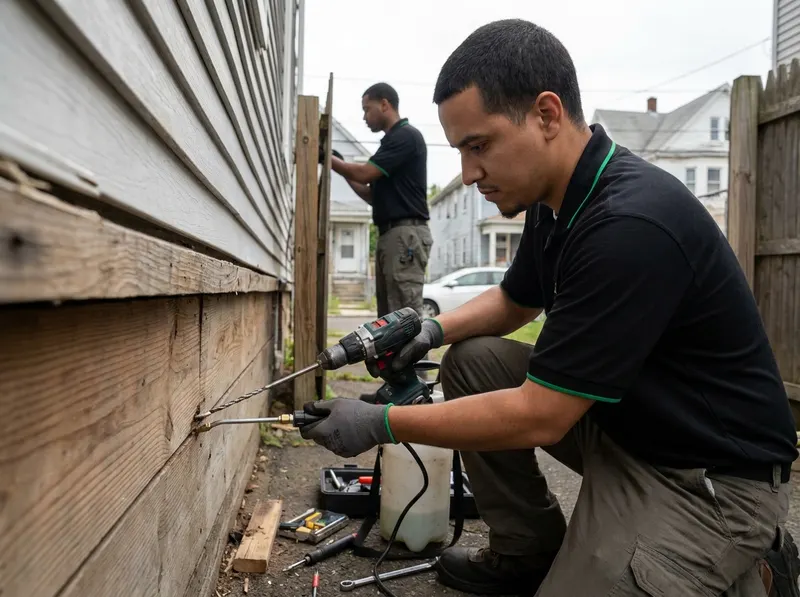
Historic Victorian, colonial, and triple-decker wood structures across Hartford, from the West End and Asylum Hill to Frog Hollow and Barry Square, regularly face wood-boring activity from *Camponotus pennsylvanicus* (black carpenter ant). Unlike termites, carpenter ants do not ingest cellulose; they excavate galleries within wood softened by roof leaks, high humidity, or plumbing drainage, leaving fibrous piles of wood shavings mixed with insect fragments known as frass. Store-bought aerosol sprays scatter foraging worker ants into secondary wall voids, worsening the infestation through budding. True colony elimination requires deploying slow-acting non-repellent products that foragers carry back to feed the reproductive queen through trophallaxis, collapsing the internal nesting hierarchy within 14 to 21 days.
Treatment selection balances the location of the nest against the structural layout of the dwelling. If active foraging trails originate along exterior tree branches overhanging a roofline in Parkville or Behind the Rocks, an exterior barrier treatment using fipronil-class chemistry targets satellite workers before entry. When coarse frass drops from ceiling joints, door casings, or subflooring near moisture sources in older Blue Hills or South End homes, targeted micro-injection into wall voids bypasses surface drywall to deliver desiccant dust directly into the excavated galleried wood. Single-structure interventions resolve isolated seasonal colonies without forcing property managers or homeowners into locked 12-month recurring contracts.
1. Structural moisture mapping and entry tracing isolate wet timber framing near roof valleys, window sills, and foundation sills. 2. Low-impact targeted baits and non-repellent transfer agents are applied precisely along active foraging paths to reach the parent colony. 3. Void injections treat hollow galleries directly, neutralizing primary nesting chambers without aerosol drift into living spaces where children and pets dwell.
Every job gets a firm, written price after a free on-site visit.
Tell us about your carpenter ant colony elimination job in Hartford and we'll send a clear, written quote, usually the same day.
 Brinova Pest Services